

Project Team
Individual
Project Duration
Jan 2022 - May 2022
Tools
Adobe XD
Photoshop
Whimsical
Key Responsibilities
User Interviews, Usability testing, Heuristic evaluation, Ideation, Wireframing, Prototyping, User research, User personas
At a glance
Brief overview of the entire project
Overview
The purpose of the testing on the Global Fluidtech Systems website was to identify critical issues and discover solutions to boost user engagement and traffic. Over the course of several months, this testing was carried out in multiple phases. From heuristic evaluation to User research, Creating user personas, User story creation, Content inventory, and Usability testing were conducted. After the testing, the data was analyzed to identify the key issues more accurately with the site. With the problems in mind, a high-fidelity prototype was created that addressed the problems by introducing a new design.
Background
Global Fluidtech Systems is a private company located in Ahmedabad, India. Their website is designed to act as a multi-national company's machinery import dealer. The goal of this research is to provide recommendations on how to boost website traffic, gain new consumers, receive product queries, and improve the overall usability of their website. The goal of the study was to discover existing pain points in order to improve the UI for target consumers. The risks of not performing the study are decreased traffic and continued lack of engagement. The hypothesis being investigated is that the site is not currently performing in a user-friendly manner.
Surveys and Interviews
In the next phase of the study, user research was conducted. The purpose of this research was to establish who the current and prospective site users are and what their goals are when visiting the site. Demographic questions revealed that the target users are typically male, with an age range of 19-30 years, either employee or student, has a bachelor’s degree, and are living In Ahmedabad city. 66.7% of participants were using laptops.
Half of the participants have visited the website of a similar company like this before and the main purpose of the website for the participant was to check products. Target users cited that they would visit the website of Global Fluidtech Systems because they are interested in checking new products, inquiring about the product, downloading the product brochure, and collecting product information.
Responses

Figure 1: Responses of the age of the users

Figure 2: Responses of the gender of the users

Figure 3: Responses of users occupations
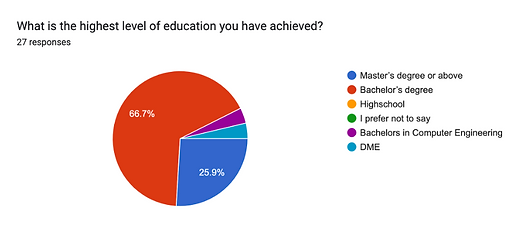
Figure 4: Responses of users with the highest level of education.

Figure 5: User responses to the website's overall usage.

Figure 6: User responses to where they live.
Heuristic Evaluation
To identify important issues with the current website, a heuristic evaluation was performed. The Jacob Nielsen 10 heuristics for the evaluation method were used because this method is a very time-efficient evaluation method compared to other methods, such as user testing. The severity scale was ranked according to Molich and Jeffries’ severity scale. The heuristic evaluation found that there is no visibility of system status. It also discovered issues with user control, consistency, and standards. and error prevention. The main issue identified is flexibility and efficiency of use.
The severity scale was ranked according to Molich and Jeffries’ severity scale. This heuristic was rated a 3 on a scale of 0-3, with 0 being a minor issue and 3 being catastrophic. There are several issues with the aesthetic and design including colors, layout, and typefaces.
The product pages have a confusing layout. The breadcrumbs were also not well designed. There was no consistency in product technical details. The major issue was that there was not any filter function to find products. Most of the issues were with poor content quality and lack of proper navigation. These issues can be easily resolved with complete information architecture so that users can get an idea about the overall sitemap of the website.
User Personas
Three major users were identified and represented in personas based on the user study.
The three personas are:
-
The Learning student
-
The working employee
-
The well-known businessman

The learning student is a 22-year-old male living in AZ. His main goals are to search for the products, check the product brochure, and gather product information.

The working employee is a 39-year-old woman living in Ahmedabad, Gujarat. Her main goals are to check the product’s technical details and know about the company and client list.

A well-known businessman is a 45-year-old man living in Ahmedabad, Gujarat. His main goals are to find products, see clientele and inquire about the product.
User Stories
User stories are a crucial component of any UX project, as they help designers and developers understand and empathize with the needs, goals, and frustrations of their users. Essentially, a user story is a brief, narrative description of a specific task or goal that a user wants to accomplish on a website, app, or product. By creating and analyzing user stories, designers and developers can gain valuable insights into their users' behaviors and needs, which they can then use to create more effective and intuitive products.
Following phase one, user research was conducted to identify the target demographic and discover their needs and expectations of the site. After creating three personas, User stories were created for each persona to better understand the common needs and expectations of site visitors. The user stories for all three personas are listed in the link below.
Content Inventory
According to user research, target consumers are more interested in checking products, gathering product information, and inquiring about products when they visit the site. During the inventory, the biggest issues discovered were in the product description and technical details section.
Since 2020, the product information has not been updated. The photo labels for the products were either missing or non-descriptive. Other errors detected included category and product brochure information. In the product details area, there is a lack of clarity and material. The terminology used on the navigation bar labels and to define various duties and activities of the organization was not written in a way that was clear to the average user. This information, for example, was labeled "download" rather than "brochure."
Brainstorming to solve pain points and frustrations
During a brainstorming session, I discovered the following Global Fluidtech Systems website paint points that I believe are critical to consider when redesigning the website. The goal of brainstorming is to create a product that is intuitive, user-friendly, and effective at resolving user pain points and frustrations. These issues will aid me in redesigning the Global Fluidtech Systems website.

Result
Following the collection of all data, important concerns were recognized, and remedies were developed.
The grading scale used to assess the effect of each identified issue is shown below.
1. Suggestion: A suggestion that describes a possible enhancement of a fix in the system, but with low importance to the participant.
2. Strong Suggestion: A suggestion to fix something that is clearly annoying the participant.
3. Minor Issue: Participant stops to think, but proceeds.
4. Major Issue: The participant faces a significant delay or starts doing try-and-error.
5. Blocker Issue: The participant gets stuck or gives up, and only proceeds with help.
Prototype
Following the first round of observational testing, the sections of the site that posed the greatest challenges to users were chosen. Following that, a prototype was constructed in an attempt to address some of the significant concerns and roadblocks that had been discovered. There were four participants in this phase of testing, all of whom had taken part in the first round. Upon first viewing, all four participants commented favorably on the site’s changes. The tasks for the prototype were comparable to those used in the initial testing. There were three scenarios, each with three tasks.

Product Page - Original Site

Product Page - Prototype

Inquiry Page - Original Site

Inquiry Page - Prototype

Product Information Page - Original Site

Product Information Page - Prototype
Conclusion
The purpose of this study was to assess current challenges at the Global Fluidtech Systems location and make recommendations for changes. The goal of this experiment was to boost traffic and attract new consumers, as well as receive product inquiries and improve the overall usability of their website. Key concerns were recognized, and remedies were developed through inventory, heuristic testing, and usability testing. Following that, participants were given the opportunity to test a prototype that included the solutions. The inquiry form, product information page, searching for products, and downloading product brochures were recognized as the primary pain areas on the site during the testing. Participants said they couldn't discover information or were frustrated trying to find the product.
What did I learn?
-
Consistency is key: The study revealed that the company's branding was not consistent across all channels, including its website, social media, and marketing materials. By establishing a consistent brand image, the company can build a stronger brand identity and improve user recognition and trust.
-
User-centered design is important: The study found that the company's website was not designed with the user in mind. By adopting a user-centered design approach, the company can create a website that is more intuitive, easier to use, and better aligned with user needs and expectations.
-
Visuals are powerful: The study revealed that users responded positively to visual content, such as photos of the company's work. By incorporating more visual content into its website and marketing materials, the company can engage users and showcase its expertise and capabilities.
Recommendation
Significant data was acquired from the testing of the original site and the prototype, pointing to key areas that need to be addressed to improve the site's usability. For a better website experience, the following problems must be fixed.
-
Inquiry form: Redesign the inquiry form to include the appropriate form fields so that the user can fill it out quickly. Also, provide the consumer the option of selecting a category and a product. This will make this section of the site more user-friendly.
-
Product Information Page: Redesign the product information page to include a detailed description section, photographs with an inquiry form, and a brochure button, allowing all participants to find product information quickly and easily.
-
Search functionality: Add a filter feature to the site so that users can quickly locate what they're looking for.
-
Overall content: Add product descriptions and curate the overall content so that users can learn more about the product quickly.
-
Navigation: Reduce the number of pages for a given product category. So that using only a few clicks, the user can reach the last page if the number of pages is reduced.